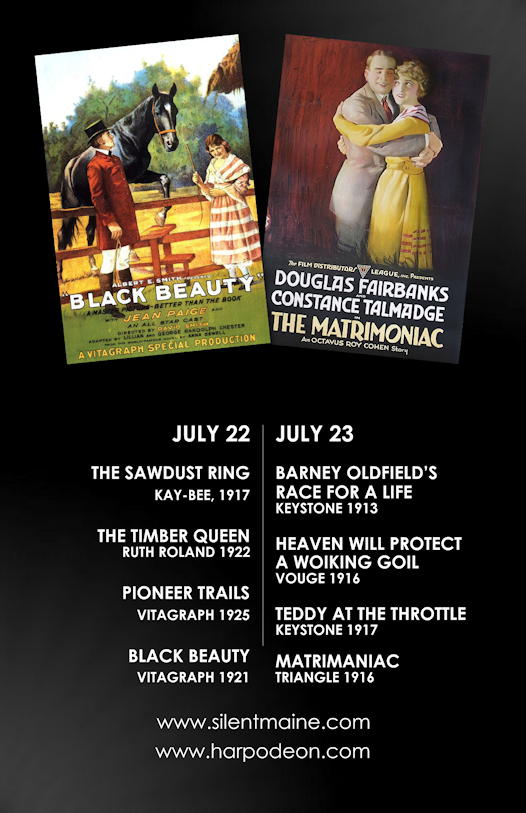


Horse & Marriage
Much of the silent era is presumed lost, although exactly how much is guesswork. By some estimates, 50% of films released before 1950 are lost, 75% of those before 1930, and 95% of all those released before 1920.
Before 1950, commercial releases were printed on nitrocellulose filmstock, commonly called nitrate. Nitrate is extremely flammable and grows increasingly unstable as it decomposes. Nitrate fires would frequently destroy entire film vaults. Additional to that, before the mid-century reevaluation of the silent era, silent films were not seen as having any value and many were simply disposed of to make room.
But non-commercial releases are another matter. Films intended to be shown at home were always printed on safety filmstock—that is, film that is nonflammable or slow-burning.
In 1922, Société Pathé Frères—the world’s second oldest film company—introduced a new amateur format: a small-gauge film 9.5mm wide that they called Pathé Baby.
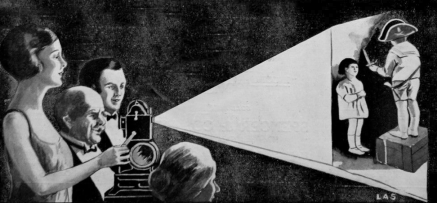
Pathé Baby was not just intended for shooting one’s own movies. Theatrical films were also printed and released on 9.5mm to be shown at home. 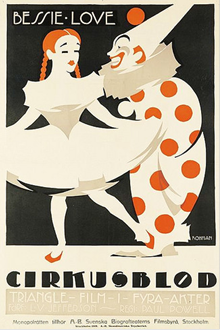 This began in France, but soon Pathex (the American division of Pathé) and Pathescope (the British division) began releasing their own Baby films on 9.5mm as well. These were universally abridgments, often reducing what had been feature-length films to no more than a few minutes, but in many cases, they represent all that is known to survive of film.
Tonight’s show begins with Bessie Love in The Sawdust Ring, a film about a girl with dreams of circus horses who, when her mother falls ill, sets out to find her long-lost father. It was assembled from two 9.5mm abridgements, one from Pathé released in 1922 and one from Pathex in 1929. As all of the company’s divisions abridged their films differently, sometimes drastically so, each additional source means more surviving footage.
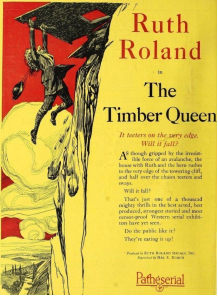 Following is an episode from The Timber Queen, “The Abyss,” produced by Ruth Roland for her own studio, Ruth Roland Serials. She also stars in the series, wherein a woman inherits a valuable lumbering concern while her cousin conspires to claim it for himself, no matter what it takes. Every possible source was used to assemble it: a French Pathé print and a Spanish one, both from 1926; a Pathescope print from 1927; and one released by Pathex in 1929.
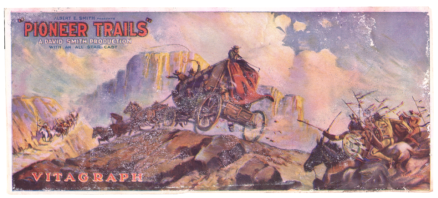
The last short that had been a feature is Pioneer Trails, a western romance and legal drama starring Cullin Landis and Alice Calhoun, assembled from a particularly long (half an hour) 1930 Pathescope abridgement and two short excerpts both released by Pathé in 1937.
This evening’s feature is the theatrical premiere of the new Harpodeon reconstruction of Black Beauty starring Jean Paige, a film that tells the story of a rogue attempting to blackmail a wealthy girl into marrying him woven around 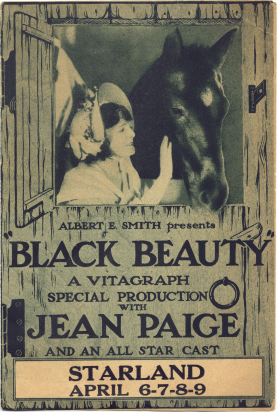 an otherwise reasonably faithful adaptation of Anna Sewell’s “autobiography of a horse.”
The survival rate of Vitagraph films is quite good compared to most of the other pioneering film companies and Black Beauty is not entirely lost. Of its original seven reels, the third, fourth, and sixth reel survive intact.
In 1929, Pathescope released a film they called Black Bess, which was a two-reel abridgement of Black Beauty. Using this footage to fill in the gaps left by the missing reels, we are allowed to watch Black Beauty substantially as it was seen when it was originally released.
Perilous Railroads
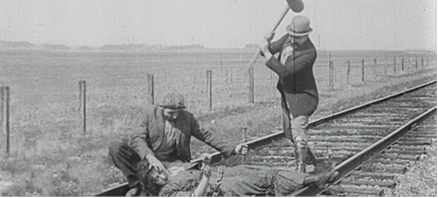
There is a persistent image in the popular conception of silent dramas of a damsel in distress tied to railroad tracks by a mustache-twirling villain in a top hat. Many believe it was in The Perils of Pauline, and it was, but not the original Pearl White serial (which was not train-centric at all). It was, rather, in the 1947 Betty Hutton spoof of it. In reality, women being bound to railroad tracks happened rarely in silent film and never outside of comedies parodying Victorian stage melodrama. It likely originated in the 1867 play Under the Gaslight, but even by the end of the nineteenth century, it was seen as a well-worn, hackneyed trope not to be taken seriously.
The first short of the evening is Barney Oldfield’s Race for a Life featuring racecar-driver Barney Oldfield, the first man to reach 60 miles per hour in an automobile, trying to beat a train to reach Mabel Normand in time to free her from the tracks.
Oldfield had been suspended from the American Automobile Association and was unable to compete in races. He was for that reason appearing in this and other films.
While the plot of Barney Oldfield’s Race for a Life is slight, Heaven Will Protect a Woiking Goil is more involved, lampooning many other clichés of Victorian melodrama: 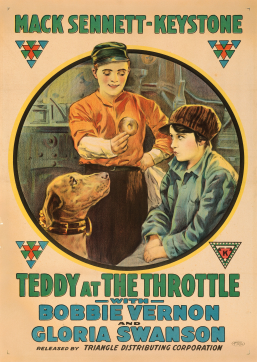 the country girl in the uncaring city, the drunken father, the lecherous employer, the corrupt cop, the heartless landlord and his suicidal tenant, and of course a woman (and her boyfriend, too) bound to the railroad tracks as a train speeds ever-nearer.
Gloria Swanson and Bobby Vernon feature alongside the star of the film, Teddy the Keystone Dog, in Teddy at the Throttle. This is a send-up of yet another trope of the Victorian stage, the defalcation of a fortune held in trust by a girl’s conniving guardian. When discovered, the man dons a top hat and chains Gloria to the tracks to seal her lips and spare himself from prison, and only Teddy can save her.
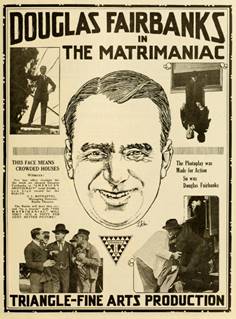 This evening’s program ends with The Matrimaniac. Starring Douglas Fairbanks and Constance Talmadge, The Matrimaniac is a comedy in which a couple attempting to elope are accidentally separated on their way to the city, leaving the groom and minister having to hop a train and then getting arrested as hobos while the bride’s disapproving millionaire father and his lawyers are in hot pursuit to stop the wedding.
The Matrimaniac was one of the last films Douglas Fairbanks made for Triangle before going on to start his own production company and soon afterwards becoming a founding member of United Artists, where he would become a star. To capitalize on the actor they had lost, Triangle would twice take the footage they shot for The Matrimaniac and rearrange and edit it into telling different stories. When Triangle released these titles—The Missing Millionaire and A Telephone Marriage—they claimed that they were entirely new Fairbanks films.
Our Accompanist
Doug Protsik
Doug has been playing and performing the “Old Time Piano” style since the early 1970s. Developed in the latter half of the 19th century the style includes ragtime, accompanying fiddle tunes for dances, foxtrots, waltzes, and other popular dance music and songs from that era. It was the predominant style when silent movies appeared around 1910 and it became a standard job of piano players to accompany the films since there was no sound.
Doug learned the art of putting together a score appropriate for silent movies from Danny Patt, who first played for the silent movies when he was growing up in Union, Maine in the 1920s. Danny’s talent for this music was reestablished in the 1980s as a growing interest in viewing old silent movies became of interest to the public once again. Since Danny passed away in 1999, Doug has been continuing this tradition of accompaniment, and has scored and performed for countless showings throughout Maine and internationally. This work led to his composing original authentic scores for silent movie restorations for Turner Classic Movies, including titles such as Hitchcock’s The Lodger and Easy Virtue.
Traditional mood themes from composers such as M.L. Lake, J.S Zamecnik, and Erno Rapée and popular themes of the era are used to create a unique score for each movie in an original and authentic way. Doug also has established a fun aspect to the performances by including “musical jokes” in his scores, challenging the audience to recognize them. All the music is memorized, arranged, and improvised by Doug to allow for a seamless flow from scene to scene. Attending a performance allows for a wonderful musical, as well as an historic and entertaining film experience.